

AI meets electrocatalysis: Lessons from three decades and a roadmap ahead
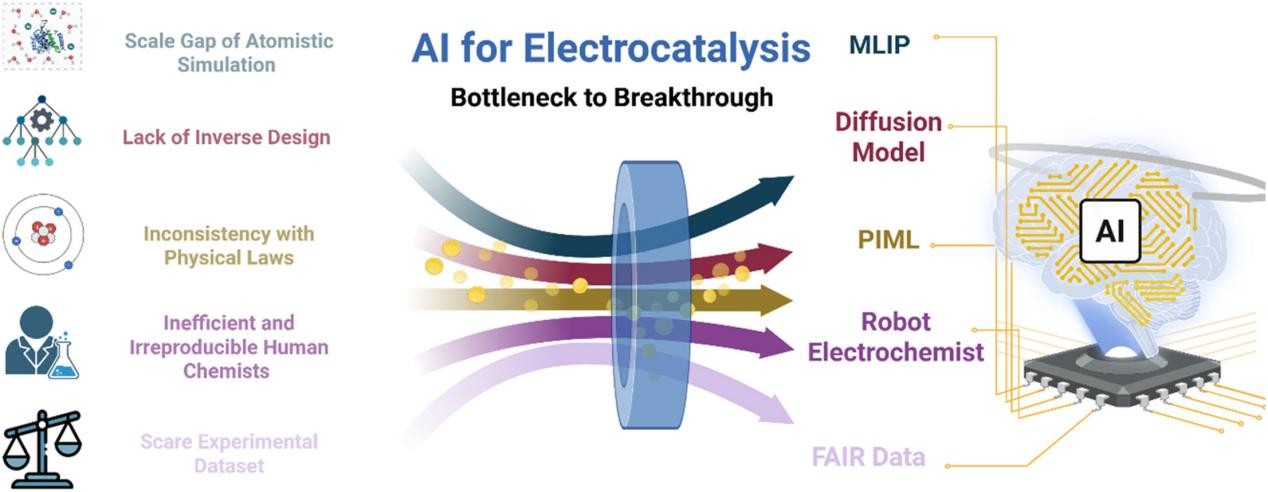
From Bottlenecks to Breakthroughs: How AI Is Reshaping Electrocatalysis.
GA, UNITED STATES, February 3, 2026 /EINPresswire.com/ -- Electrocatalysis sits at the heart of clean hydrogen production, fuel cells, and carbon dioxide conversion, yet progress toward scalable, high-performance catalysts has remained frustratingly slow. A growing body of research now suggests that artificial intelligence (AI) may be key to breaking this bottleneck—but only if it is used wisely. By reviewing three decades of AI applications in electrocatalysis, researchers reveal how the field has shifted from isolated data analysis toward end-to-end, data-driven discovery. The work highlights a critical turning point: AI is no longer just accelerating experiments, but beginning to reshape how electrocatalysts are designed, evaluated, and understood at a fundamental level.
Despite intense global investment in clean energy technologies, electrocatalyst development still struggles with deep-rooted challenges. Atomistic simulations rarely translate into device-scale performance, experimental workflows remain labor-intensive and difficult to reproduce, and most machine-learning models lack physical interpretability. At the same time, the demand for efficient catalysts in hydrogen production and carbon-neutral chemical manufacturing continues to rise. The rapid expansion of artificial intelligence (AI) capabilities—ranging from physics-informed models to autonomous experimentation—has opened new possibilities, but also exposed systemic weaknesses in data quality and integration. Based on these challenges, a comprehensive reassessment of how AI should be deployed in electrocatalysis has become urgently needed.
Addressing this need, a review published (DOI: 10.1016/j.esci.2025.100515) in December 2025 in eScience by an international team of researchers from the University of Michigan, Xiamen University, and the University of Oxford examines 30 years of AI-driven electrocatalysis research. rather than cataloging past successes, the authors identify why many AI approaches have failed to deliver real-world impact—and how recent advances in machine learning, data infrastructure, and laboratory automation may finally change that trajectory. the review positions the field at a decisive moment, where strategic choices could determine whether AI delivers genuine breakthroughs or remains largely incremental.
The authors identify five structural bottlenecks that have limited the effectiveness of AI in electrocatalysis: mismatches between atomic-scale models and macroscopic performance, the immaturity of inverse catalyst design, poor physical consistency of black-box algorithms, inefficient manual experimentation, and a shortage of reliable experimental data. To overcome these barriers, recent work has introduced machine-learning interatomic potentials capable of simulating dynamic catalyst restructuring at unprecedented scales, alongside generative AI models that propose new materials rather than merely screening known ones.
Equally transformative is the rise of physics-informed machine learning, which embeds electrochemical laws directly into neural networks, enabling models that are both predictive and interpretable. The review also highlights the emergence of autonomous “robotic electrochemists” that integrate AI decision-making with high-throughput synthesis and testing. Together, these developments suggest that electrocatalysis is shifting from a trial-and-error discipline toward a closed-loop, self-improving discovery system—provided that data quality and model transparency are treated as core scientific priorities.
Importantly, the authors caution against viewing AI as a universal solution. They emphasize that poorly curated data and physically inconsistent models risk amplifying errors rather than accelerating discovery. Instead, they argue that the most impactful advances will come from combining AI with electrochemical theory, standardized data practices, and interdisciplinary collaboration. In their view, the true value of AI lies not in replacing human expertise, but in enabling scientists to ask deeper questions and explore chemical spaces that were previously inaccessible.
If these challenges are addressed, AI-driven electrocatalysis could significantly accelerate the deployment of clean energy technologies, from large-scale hydrogen production to carbon-neutral fuel synthesis. The review suggests that the next breakthroughs will likely emerge where automated laboratories, physics-informed models, and open data infrastructures converge. Beyond energy applications, the lessons outlined may influence how AI is applied across chemistry and materials science more broadly. By reframing AI as an integrated scientific partner rather than a standalone tool, the work points toward a future in which catalyst discovery becomes faster, more reliable, and more directly connected to real-world impact.
DOI
10.1016/j.esci.2025.100515
Original Source URL
https://doi.org/10.1016/j.esci.2025.100515
Lucy Wang
BioDesign Research
email us here
Legal Disclaimer:
EIN Presswire provides this news content "as is" without warranty of any kind. We do not accept any responsibility or liability for the accuracy, content, images, videos, licenses, completeness, legality, or reliability of the information contained in this article. If you have any complaints or copyright issues related to this article, kindly contact the author above.
